The Roland S-Series Samplers: From 12-Bit Character to 16-Bit Clarity
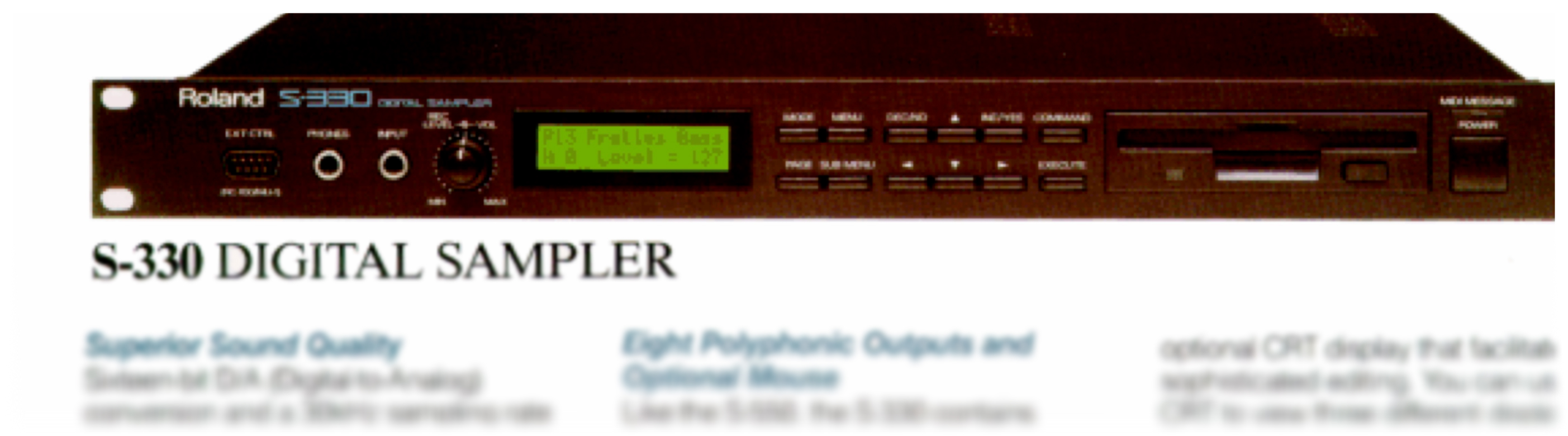
Roland’s S-series samplers represent one of the most cohesive product families in the history of digital sampling. Spanning from 1987 to the early 1990s, the line evolved from an affordable rack-mount entry point through a flagship 16-bit instrument, with each model sharing design philosophy, interface conventions, and — in the case of the 12-bit models — direct sound library compatibility.
This guide covers the full S-series lineup: the hardware, the sound, the accessories, and the tools available for working with these instruments in the present day.
The S-Series Timeline
Roland released the S-series in distinct generations:
1987 — The 12-bit foundation:
- S-550 — the full-featured 2U rack sampler with expanded memory and RGB monitor output
- S-330 — the compact 1U rack sampler offering the same engine at a lower price
1989 — The workstation:
- W-30 — a sampling workstation packaging the 12-bit engine with a 61-key keyboard and sequencer
1990 — The 16-bit generation:
- S-770 — the 16-bit flagship with stereo sampling, 24-voice polyphony, and digital I/O
Early 1990s — Budget 16-bit variants:
- S-750 — a more affordable version of the S-770
- S-760 — a further cost-reduced 16-bit sampler
The 12-bit models (S-330, S-550, W-30) share the same core architecture and are functionally interchangeable for most sampling tasks. The 16-bit models (S-770 and descendants) represent a distinct generation with different capabilities and file formats.
The 12-Bit Sound
The S-330, S-550, and W-30 all use the same 12-bit linear sampling engine. This shared architecture means:
- Identical sound character — the same converters produce the same distinctive lo-fi warmth
- Compatible disk format — sound libraries created on one device load on any of the three
- Same filter design — resonant low-pass filter with 4-stage envelopes (4 levels, 4 rates) across all models
- Same voice architecture — 16-voice polyphony, 8-part multitimbral operation
The 12-bit resolution gives these samplers their characteristic sound. At 30 kHz sample rate with 12-bit depth, the quantization adds a subtle grittiness and harmonic texture that distinguishes S-series recordings from cleaner 16-bit samplers. This wasn’t a design goal — it was a limitation of affordable 1987 technology — but it became a valued sonic quality as tastes evolved.
The sample rates are variable: 15 kHz provides longer sampling time (up to 28.8 seconds on the S-330) at reduced fidelity, while 30 kHz offers the best quality the 12-bit converters can deliver. Most users working with the S-series today prefer 30 kHz for its balance of character and clarity.
The Hardware
Roland S-330
The S-330 is where most people encounter the S-series today. Its 1U rack form factor, lower original price, and the availability of a free web editor make it the most accessible entry point to 12-bit Roland sampling.
Key specs:
- 1U rack-mount
- 16-voice polyphony, 8-part multitimbral
- 12-bit, 15/30 kHz sample rates
- 8 individual outputs + stereo mix
- Composite video output
- 3.5” 2DD floppy disk storage
The S-330’s main limitation relative to the S-550 is memory — less onboard RAM means shorter total sampling time and fewer simultaneous samples. For editing and sound design, the two are equivalent.
Roland S-550
The S-550 was Roland’s full-featured 12-bit offering. Its advantages over the S-330 are primarily practical rather than sonic:
- Expandable memory — ships with 512 KB, expandable to 2 MB
- RGB monitor output — a dedicated 8-pin DIN connection producing color video at 640x200, versus the S-330’s monochrome composite
- 2U form factor — more panel space for rear connections
The S-550 is the professional choice when rack space isn’t constrained and the color display is valued. Its expanded memory allows loading larger sound libraries without swapping disks.
Roland W-30
The W-30 takes the 12-bit S-series engine out of the rack and into a keyboard workstation:
- 61-key velocity-sensitive keyboard
- 16-track sequencer with 50,000-note capacity
- Built-in LCD for editing without an external monitor
- Same sampling engine as the S-330 and S-550
The W-30 found a devoted following in the early UK rave and jungle scenes, where its all-in-one design and distinctive 12-bit sound character made it a practical production tool. Its cultural footprint extends across electronic music, though it shares its sonic DNA with the S-330 and S-550.
Roland S-770
The S-770 represents Roland’s leap to 16-bit sampling:
- 16-bit resolution at up to 48 kHz sample rate
- Stereo sampling
- 24-voice polyphony, 16-part multitimbral
- Up to 18 MB of memory
- Digital I/O — S/PDIF (coaxial)
- SCSI for hard drive storage
The S-770 is a different beast from the 12-bit models. It’s cleaner, more detailed, and more capable — but it lacks the characterful grit that draws people to the S-330 and S-550. The two generations serve different musical purposes, and neither is inherently superior.
The Control Hardware Problem
All S-series samplers share a distinctive design choice: graphical editing through an external video display and pointing device. This was forward-thinking in 1987 — most competing samplers used small LCD screens and banks of buttons — but it created a dependency on specific control hardware that would become problematic decades later.
MU-1 Mouse
The Roland MU-1 is an MSX-compatible mouse manufactured by Mitsumi. It connects to the sampler’s 9-pin mouse port and controls a cursor on the external display.
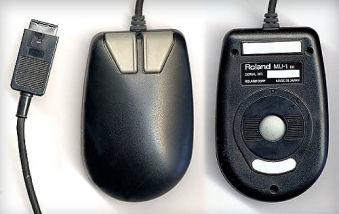
The MU-1 uses the MSX mouse protocol, which is incompatible with PC, Amiga, or Atari mice of the same era. This protocol specificity, combined with the MSX platform’s obsolescence, makes finding a working mouse increasingly difficult. Any MSX-compatible mouse works as a substitute, but the MSX ecosystem itself has been defunct for decades.
RC-100 Remote Controller
The Roland RC-100 is a dedicated control surface with physical buttons and a jog wheel. It connects to the same port as the MU-1 and provides button-driven navigation of the graphical interface.
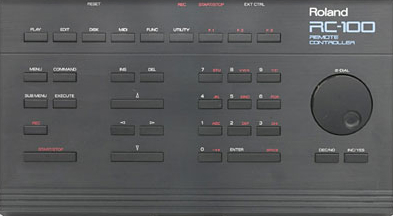
The RC-100 is extremely rare. It was produced in smaller quantities than the MU-1 and is harder to find on the used market.
Modern Solutions
Several approaches exist for controlling S-series samplers without original hardware:
- DIY adapters — Arduino-based MSX mouse emulators, PS/2 to MSX converters
- Windows control software — various community-developed applications
- The audiocontrol.org web editor — a free, browser-based editor that communicates via MIDI SysEx
The Web Editor
The audiocontrol.org S-330 web editor bypasses the control hardware problem entirely. It communicates directly with the S-330 via MIDI System Exclusive messages — the same protocol Roland included for computer-based editing.
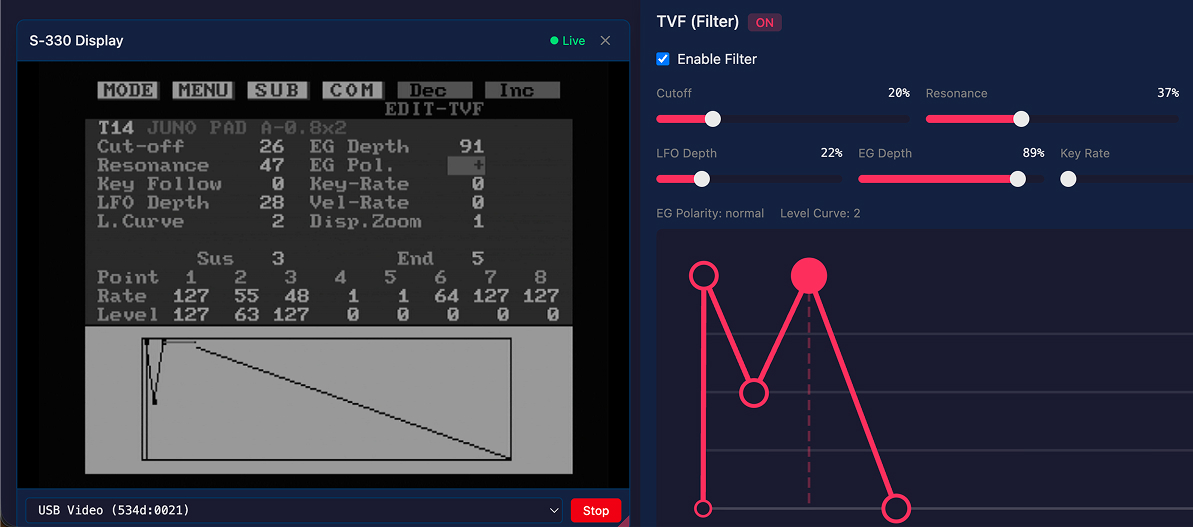
The editor provides:
- Patch editing — keyboard mapping, key modes, tone assignment
- Tone editing — filter, envelopes, LFO, wave points
- Interactive envelope editors — drag points on 4-stage TVF and TVA envelopes
- Real-time bidirectional sync — changes in the browser update the hardware and vice versa
- Video display integration — embed the S-330’s native screen via USB capture device
- Virtual front panel — replicate hardware button controls from the browser
The editor requires only a standard MIDI interface and a browser with Web MIDI support (Chrome, Edge, or Opera). Full documentation is available in the S-330 editor guide.
Choosing an S-Series Sampler
For musicians and producers considering an S-series purchase:
Choose the S-330 if:
- You want the 12-bit S-series sound in the smallest form factor
- You plan to use the web editor for editing
- Rack space is a consideration
- Budget is a factor (generally the most affordable S-series model)
Choose the S-550 if:
- You need more sample memory
- You want a color RGB display for native editing
- You value the expanded I/O options
Choose the W-30 if:
- You want a keyboard instrument, not a rack module
- You need an integrated sequencer
- You want the 12-bit sound in a live performance context
Choose the S-770 if:
- You want clean 16-bit sampling
- You need stereo sampling capability
- You require digital I/O (S/PDIF)
- Maximum polyphony and memory are important
Related Content
- Roland S-330 Overview — detailed specs, accessories, and the web editor
- Roland S-550 Overview — the full-featured 12-bit rack sampler
- Roland S-770 Overview — the 16-bit flagship
- Roland W-30 Overview — the sampling workstation
- Roland MU-1 Mouse Guide — history and alternatives
- Roland RC-100 Remote Controller Guide — the dedicated control surface
- S-330 Web Editor — launch the free browser-based editor
- S-330 Editor Documentation — setup and usage guide
- A Free Web Editor for the Roland S-330 — the original blog post about the editor