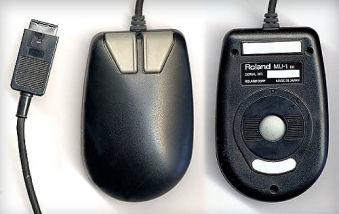
The Roland MU-1 is the primary pointing device for Roland’s S-series samplers. It connects to the sampler’s mouse port and controls a cursor on the composite video output, providing graphical access to sample editing, envelope shaping, and parameter adjustment.
Background
Roland designed the S-series samplers around a graphical user interface displayed on an external monitor. Unlike most rack-mount samplers of the era, which relied on small LCD screens and button navigation, the S-330, S-550, and W-30 output a full-screen display showing waveform editors, envelope curves, and menu systems.
This interface requires a pointing device, and Roland chose the MSX mouse standard — a protocol from the MSX home computer platform developed by ASCII Corporation and Microsoft in the early 1980s. The MU-1 was manufactured by Mitsumi and uses a 9-pin D-sub connector carrying the MSX mouse protocol.
MSX Mouse Protocol
The MSX mouse standard defines a specific communication protocol over a 9-pin connector. Key characteristics:
- 9-pin D-sub connector (DE-9)
- Quadrature encoding for X and Y axes
- Two buttons (left and right click)
- Active polling by the host device
This protocol is incompatible with the more common serial mouse standards used by PC (Microsoft/Logitech), Amiga, and Atari computers of the same era. A standard PC serial mouse will not work in the S-330’s mouse port — the electrical interface and signaling protocol are different.
Compatible Hardware
| Device | Notes |
|---|---|
| Roland S-330 | Primary use case |
| Roland S-550 | Same mouse port and protocol |
| Roland W-30 | Same mouse port and protocol |
| MSX computers | Original target platform |
Finding an MU-1
The MU-1 was manufactured in limited quantities and has not been produced for decades. Sources include:
- Used gear marketplaces — eBay, Reverb, Yahoo Auctions Japan
- MSX computer communities — since any MSX mouse is compatible
- Roland-specific forums — occasionally surface in classified sections
Prices vary widely depending on condition and availability. Working MU-1 units can sell for several times their original retail price.
Alternatives to the MU-1
Other MSX Mice
Any MSX-compatible mouse will work with the S-330. Notable options:
- Philips SBC 3810 — a common MSX mouse found in European markets
- Panasonic FS-JM1 — another MSX mouse option
- Various third-party MSX mice — any mouse labeled “MSX compatible” uses the same protocol
MSX mice share the same 9-pin connector and protocol, making them interchangeable with the MU-1 for S-series sampler use.
DIY Adapters
Several community projects exist for building adapter hardware:
- Arduino-based MSX mouse emulators — microcontroller circuits that translate modern USB mouse input to MSX protocol
- PS/2 to MSX adapters — convert PS/2 mouse signals to MSX format
These projects require electronics assembly skills and sourcing specific components.
Roland RC-100 Remote Controller
The RC-100 is an alternative control surface that connects to the same port. It replaces the mouse with physical buttons and a jog wheel, offering a different workflow for navigating the sampler’s interface.
The Web Editor
The audiocontrol.org S-330 web editor eliminates the need for original control hardware entirely. It communicates with the S-330 via MIDI System Exclusive messages, providing a modern browser-based interface for all editing tasks that are accessible through SysEx.
The web editor does not replace the mouse for every function — certain operations like sampling and disk management are only available through the sampler’s native interface — but it covers patch editing, tone editing, envelope shaping, and real-time parameter control.
See Also
- Roland S-330 Overview — specs, accessories, and related devices
- Roland RC-100 Remote Controller — the alternative control surface
- S-330 Web Editor — the free browser-based editor
- S-330 Web Editor Documentation — setup and usage guide
- The Roland S-Series Samplers — history of the full product line